
A note by EkStep Foundation, March 2026
100 AI DIFFUSION PATHWAYS BY 2030
A race to deploy the most powerful technology in human history to benefit the billions who need it most.
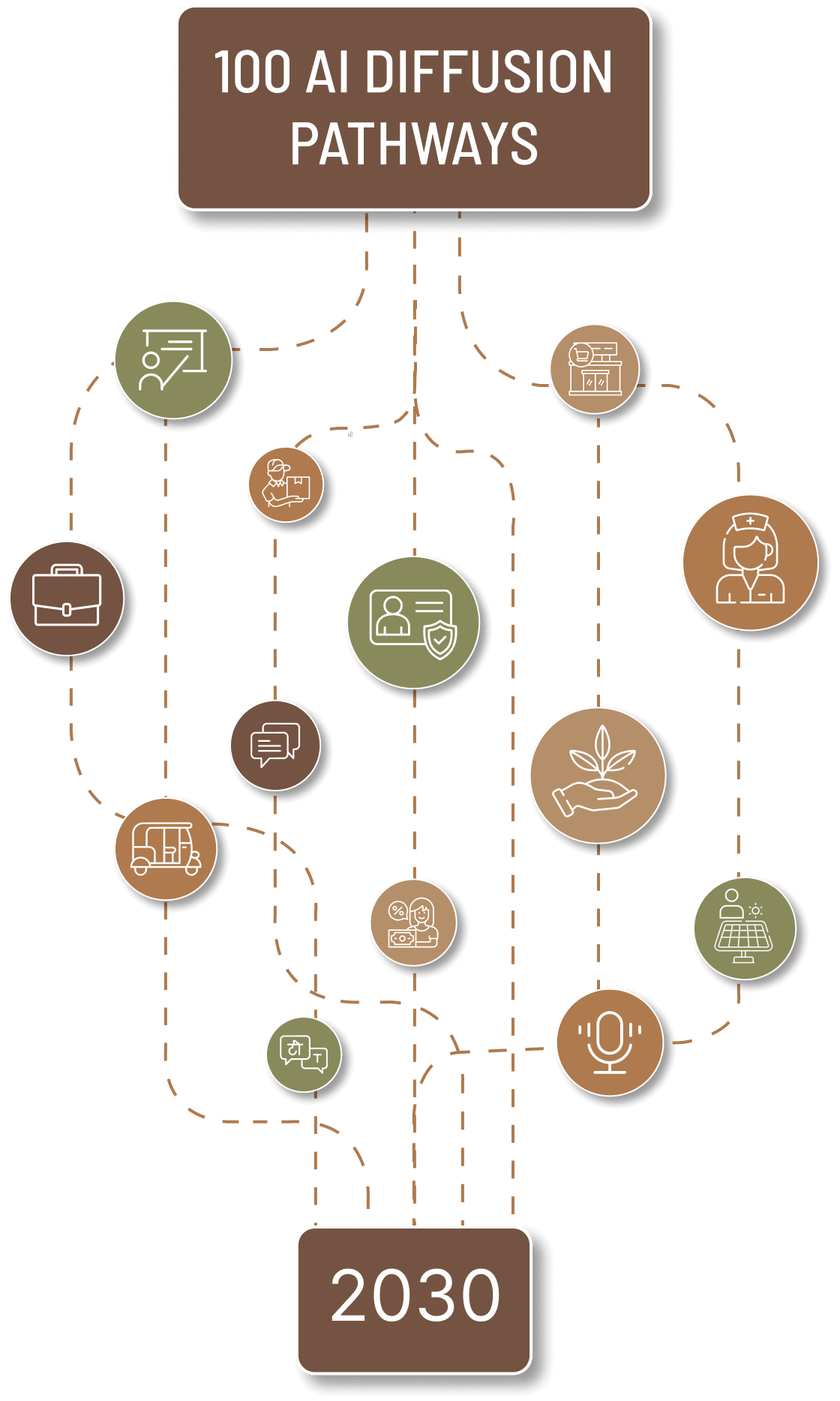
Shouldn't technology reach those who need it the most, fastest?
“Productivity gains from AI follow a progression—first at the level of the individual, then the team, then the organisation, and finally society. The last step—societal productivity—is the hardest.”
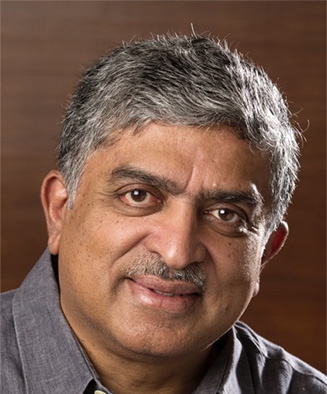
Nandan Nilekani, Raisina Dialogue 2026
The most transformative technology in human history should reach the people whose lives it can transform the most, and soon, but deploying AI in the real world is extraordinarily difficult. It is expensive, complex, and risky at scale. A successful deployment journey goes well beyond technology - it involves assembling the resources and know-how, making choices, and acting within resource constraints to advance towards a desired outcome.
A diffusion pathway packages the lived experience of deploying AI at scale into playbooks and toolkits for other adopters, dramatically reducing their learning costs, time, and risk. Since AI is a general-purpose technology that could benefit billions—touching agriculture, health, education, governance, livelihoods, and dozens more—a single pathway isn’t enough. Each sector, country and organisational context carries its own data and resource constraints, trust relationships, and failure modes.
A diverse group of eleven organisations with overlapping self-interests and united by shared beliefs recently launched an effort to achieve 100 AI diffusion pathways by 2030. Diffusion pathways work. Here is the evidence, the beliefs and an invitation to join.
The Proof
Shared deployment knowledge compressed adoption time by over 90% across three successive adopters:
The Government of Maharashtra (India) built MahaVISTAAR, an AI agricultural advisory service, from scratch: institutional architecture, data pipelines, government alignment, and 30 partner organisations. Over 3 million farmers (of the 16 million) now use it.
Learn more9
months
Maharashtra — MahaVISTAAR
Built from scratch: institutional architecture, data pipelines, government alignment, and 30 partner organisations. 3M+ farmers.
Ethiopia’s ATI , drawing on Maharashtra’s pathway, built a comparable deployment in one-third the time, without rediscovering which architectures work in the field.
Learn more3
months
Ethiopia — ATI
Drew on Maharashtra's pathway to build a comparable deployment in one-third the time
67% fasterAmul’s Sarlaben launched, serving 3.6 million farmers, 40 million cattle, and 2 billion milk transactions a year—drawing on two full deployment cycles of shared learning already available.
Learn more3
weeks
Amul — Sarlaben
Two deployment cycles of shared learning available 3.6M farmers, 40M cattle, 2B milk transactions/year.
97% fasterWhat was shared across deployments was specific and actionable: reusable technical components, data governance models, documented failure modes, operational playbooks for institutional alignment, safety guardrails, training approaches refined in the field, all of which cut deployment costs in subsequent deployments. And the compression accelerated as the shared knowledge base grew, because each new deployment added to the stock of reusable assets available to subsequent adopters. The later adopters were better informed, not necessarily better resourced.
What a Pathway Is, and Isn’t
A diffusion pathway is different from a case study, a white paper, or a best-practice guide.
It’s written from the next adopter’s perspective, not the builder’s. A case study tells you what someone did. A pathway gives you know-how - it tells you what you would need to do, in a specific context, and what assets you can take off the shelf instead of building from scratch.
Two components
 A Deployment Playbook:
the documented lived experience of deploying AI, which goes well beyond models and hardware - Who needed to be in the room, which design choices mattered and which didn’t, how institutional trust was preserved, onboarding stakeholders and end users etc
 A Reusable Toolkit:
technical assets, data pipeline governance templates, safety guardrails, procurement strategies, evaluation benchmarks, training materials, scale-up and stakeholder onboarding strategies that another adopter can use directly.
Why AI Deployment Is So Hard Without Shared Pathways
Three bodies of evidence confirm that AI’s real difficulty is institutional, not technological - a live deployment, a cross-sector study, and the historical record.
01 A Live Deployment
Building MahaVISTAAR required designing sustainable data pipelines that farmers and government institutions could trust, ensuring the system works across Marathi dialects, and catching failure modes (e.g., wrong dosage advice, misread crop conditions) before deployment. Several government bodies, data providers, and research institutions, as well as farm extension workers, had to align before a single farmer could use it. The AI model was the smaller part of a nine-month effort. MahaVISTAAR didn’t happen because one organisation got it right. It happened because thirty organisations decided that getting it right mattered more than getting it done quickly.

02 A Cross-Sector Study
The Use Case Adoption Framework 4 (UCAF) examined hundreds of AI use cases across agriculture, health, education, and government and found a consistent pattern- technology accounted for only roughly 30% of what reaching scale required. Factors like data readiness, language support, workforce adaptation, accountability guardrails, and organisation-wide alignment accounted for the remaining 70%, and this proved consistent across sectors and continents.

03 The Historical Record
Jeffrey Ding’s research on general-purpose technologies shows that the electric dynamo took fifty years to produce widespread economic gains, not because the technology was unavailable, but because adopters independently rediscovered how to organise around it. Michael Mazarr’s RAND study and Sangeet Paul Choudary’s Reshuffle reach the same conclusion about AI: the competitive challenge is social and institutional, not technological. The fifty-year lag is a failure of knowledge sharing. Diffusion pathways compress this lag.
Why diffusion pathways matter beyond the evidence
Technology does not distribute and transform lives by itself. Smallholder farmers, under-resourced health workers, and teachers in underfunded schools are rarely the first to benefit from a new capability and often the last. Reaching them requires deliberate effort.

No single actor is enough
Deployment knowledge spans organisations, sectors, and geographies. It only becomes useful when it comes together in a real-world deployment — and is shared for the next one.

The cost of waiting is real
It is measured in decisions made today without knowledge that already exists somewhere in the world. Populations that never see a benefit from AI become resistant to it — constraining markets, trust, and political will.

AI must add to agency
The goal is not algorithms that replace people. It is people empowered by knowledge that was previously out of reach — who understand more and judge better because of it.
3.6M
farmers
Amul System — A Concrete Example
Across the Amul system, 3.6 million farmers manage livestock with access to only 1,400 vets. The goal is not an algorithm that replaces the vet — it is a farmer who understands more and judges better because knowledge that was previously out of reach is now available to her.
A farmer who becomes a better farmer. A teacher who becomes a better teacher. A health worker who makes better judgements. Not people made dependent on technology — people empowered by it.
Who Has Committed
Twelve founding organisations committed in February 2026:
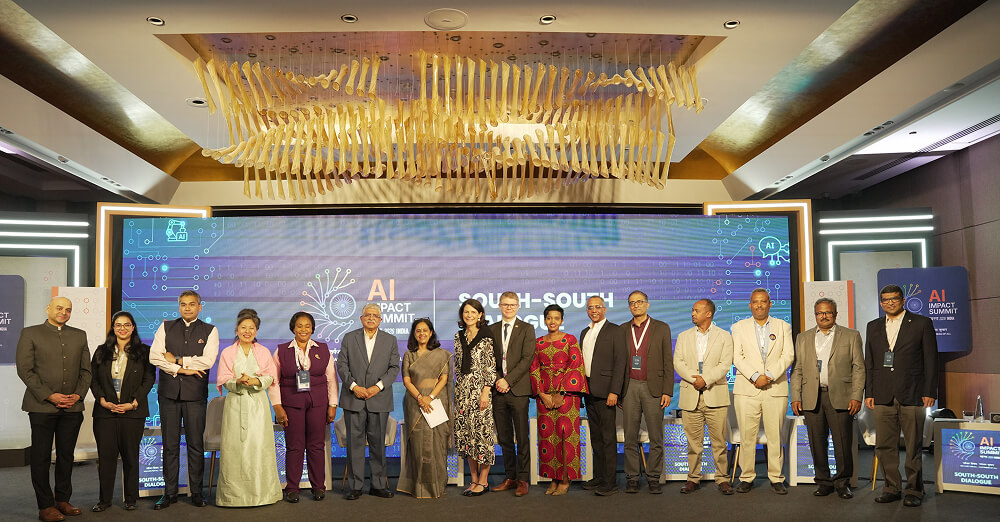
Anthropic, Carnegie India, EkStep Foundation, the governments of Ethiopia, the Gates Foundation, Google Data Commons, IIIT-B, Italy, Kenya, the Observer Research Foundation, Qhala and UNDP came together, on the sidelines of the AI Impact Summit in Delhi, and set a target of 100 pathways by 2030. Several are already live.









Videos & Articles
AI Diffusion & the 100by30 Commitment
INDIA AI IMPACT SUMMIT 2026
ATLANTIC COUNCIL
Feb 12
BABL AI
Feb 20
BW BUSINESSWORLD
2026
Use case adoption framework
Published with Carnegie India
AI Adoption Journey for Population Scale
Shalini Kapoor & Tanvi Lall · Carnegie Endowment for International Peace · January 2026
Why AI adoption at scale remains elusive. Introduces the Use Case Adoption Framework (UCAF) — moving AI out of pilot purgatory and into scalable deployment. Identifies cross-sector horizontal enablers: data readiness, language, voice, workforce reimagination, and accountability guardrails.
Read at Carnegie EndowmentThe Invitation
There are four ways to contribute to the effort:
Illustrate a pathway
If you’ve deployed AI at scale or know of a deployment, document the lived experience - the architectural decisions, the institutional work, the failure modes that only surfaced in the field.
Use a pathway
If you’re ready to deploy, use what exists. Your starting point will be far ahead if you do so.
Strengthen a pathway
If your expertise is in AI safety, workforce adaptation, data governance, or language support, contribute to and strengthen a pathway that benefits all deployments built on it.
Build a new pathway
If you see a sector, country or community where no pathway exists yet, build it there. Document the journey and share. The knowledge you create will travel to contexts you can’t anticipate, serving people you’ll never meet.
100 Pathways to AI Diffusion by 2030
Will your organisation be part of building it?
FREQUENTLY ASKEDQUESTIONS
Why Pathways? Why Diffusion?
The problem AI diffusion solves, and why structured pathways are the answer
Q0: Why does AI diffusion matter, and why do we need pathways?


The problem AI diffusion solves, and why structured pathways are the answer
Q0: Why does AI diffusion matter, and why do we need pathways?
AI capability is no longer scarce. Frontier models can reason, translate, summarise, and infer across virtually every domain. And yet, for most people — especially those at the base of the pyramid — AI remains invisible. The crisis is not invention. The crisis is implementation.
Consider a farmer in Maharashtra. Even with access to a frontier model, the interaction would likely default to English; the advice would not be grounded in local crop data or soil conditions; there would be no institutional accountability behind the answer. Research across hundreds of AI deployments in agriculture, health, education, and governance found a consistent pattern: technology accounts for roughly 30% of what reaching scale requires. The other 70% — data readiness, language support, workforce adaptation, accountability guardrails, and organisation-wide alignment — is what actually determines whether a deployment reaches people or stalls.
There are two races underway. The race to the bottom is driven by private capital maximising returns through engagement, advertising, and extraction. It requires no coordination and it is fast. The race to the top requires deliberate institutional effort to route AI’s gains to the many rather than concentrating them among the few. 100 AI Diffusion Pathways by 2030 is the counter-architecture: demonstrating in practice that AI can scale upward in capability while scaling outward in benefit.
The deeper problem is the learning cost. Jeffrey Ding’s research on general-purpose technologies shows that the electric dynamo took fifty years to produce widespread economic gains — not because the technology was unavailable, but because adopters independently rediscovered how to organise around it. Without pathway infrastructure, every new AI adopter starts from zero, independently rediscovering architecture patterns, safety frameworks, data integrations, and coordination models. Diffusion pathways make learning cumulative rather than repetitive.
The proof is already visible. MahaVISTAAR (Maharashtra’s agricultural AI system) took nine months to deploy from scratch. Ethiopia’s ATI drew on that pathway and was operational in three months. Amul’s Sarlaben built on two full deployment cycles and was running in three weeks. That compression — from months to weeks — is what structured pathways make possible. At one hundred pathways, diffusion becomes systematic.
What Is a Pathway?
Definition, structure, examples, and quality
A pathway is a structured, reusable record of how AI was deployed at scale in a specific context. It has two mandatory components: a deployment playbook (the step-by-step operational guide) and a reusable toolkit (the assets, code, benchmarks, and safety guardrails that the next deployer can use directly). A pathway compresses the learning time, cost, and risk for the next adopter.
A pathway is not a case study, a white paper, a technology specification, or a best-practice guide. A case study tells you what an organisation did; a pathway tells you what you would need to do. If it does not make another adopter’s AI implementation journey easier, it is not a pathway.
MahaVISTAAR (Maharashtra’s agricultural AI system) is the most fully documented pathway to date. Ethiopia’s ATI deployment drew directly from this pathway and was operational within three months. Amul’s Sarlaben built on two complete deployment cycles and was running within three weeks. Additional pathways are being actively documented and will be made available through the initiative’s shared repository.
The target means 100 distinct, validated deployment experiences documented to the two-component standard, spanning different sectors, geographies, and organisational contexts. The number reflects the scale of diversity in real-world AI deployment — across agriculture, health, education, governance, and other domains. A small set of well-resourced deployments, however thoroughly documented, would not satisfy the target. This number is also such that we can bend and accelerate the arc of AI towards those whose lives it can transform the most.
A pathway counts toward the target when it is sufficiently complete for another organisation to use as a genuine starting point. Progress will be reported publicly, with the shared repository serving as the primary record.
Safety is a structural element of every pathway, not a standalone section. The reusable toolkit that each pathway must include contains safety guardrails: evaluation benchmarks for harm detection, documented failure modes and how they were identified and addressed, accountability mechanisms, and criteria for when a deployment should be paused or reviewed. Safety work done in one deployment context travels to the next — a new deployer inherits the safety checkpoints developed through prior deployments, and adds to them.
Participating in the Commitment
Who it’s for, how to join, and the value proposition
Pathways serve three primary audiences. First, deploying organisations — governments, cooperatives, ministries, and agencies that want to deploy AI at population scale and need a starting point grounded in real experience. Second, builders and orchestrators — organisations that have deployed or helped deploying organisations deploy AI at scale and can document their experience for others. Third, enabling organisations — those with expertise in AI safety, data governance, language support, or workforce adaptation who can strengthen existing pathways.
There are four contribution modes. If you have deployed AI at scale, you can Illustrate: document the lived experience and create a pathway. If you are ready to deploy, you can Use: adopt an existing pathway to reduce your learning cost and time — with the responsibility to pay it forward by strengthening the pathway or documenting your own experience. If your expertise is in AI safety, data governance, or workforce adaptation, you can Strengthen: improve existing pathways. If you see a sector or community with no pathway yet, you can Build one from scratch. To connect, reach out to any of the eleven founding organisations or to GIS, which serves as the secretariat.
The answer depends on who you are:
For a deploying government or institution: you gain access to proven deployment playbooks and reusable toolkits that compress your timeline from years to months.
For a technology company or frontier lab: your tools get used in real-world deployments at population scale, building evidence, increasing adoption, and demonstrating responsible use.
For a funder or development organisation: you invest in a declining marginal cost curve — each successive batch of pathways costs less because shared infrastructure accumulates. Your funding builds permanent public goods, not one-off projects.
For a knowledge partner or think tank: you gain access to the most detailed, operationally grounded documentation of AI deployment at scale that exists anywhere.
Running the Commitment
Operations, targets, and sustainability
The primary ask is knowledge and time. The four contribution modes — Illustrate, Use, Strengthen, Build — are principally about documenting deployment experience, using and improving existing pathways, and building new ones where none exist. None of these require a financial commitment to participate.
Pathways can spread along sector lines (agriculture to agriculture across countries) or along institutional lines (state government to state government across sectors). Both patterns are already visible. The six-dimension framework makes cross-sector transfer possible because the non-technology dimensions — institutional transformation, ecosystem design, workforce absorption, operating model — are not sector-specific. The sector-specific parts sit primarily in the technology shifts, while the 70% non-technology dimensions transfer more readily across sectors.